
How DoneHat compares to other AI visibility and GEO providers
A direct comparison guide for teams evaluating DoneHat against broad AI platforms, SEO suites, and newer GEO tools.
Who this guide is for
Founders, SEO leaders, and product marketers
Summary
DoneHat is best evaluated as an AI visibility measurement and remediation workflow, not as a general-purpose AI model platform or legacy SEO rank tracker.
The strongest fit is a B2B software team that needs buyer-question monitoring, source evidence, fix briefs, and before/after proof.
A broader enterprise AI platform may be better when the primary need is model hosting, internal knowledge search, or custom application development.
Short answer
DoneHat compares best against tools that monitor how buyers encounter a brand in AI answers. It is not trying to replace IBM Watson, Microsoft Azure AI, or other broad AI platforms. Those systems help teams build or deploy AI capabilities; DoneHat helps marketing, growth, and SEO teams measure whether AI systems mention the brand accurately when buyers ask purchase-intent questions.
If the question is 'which platform should run our internal AI workloads,' DoneHat is not the right answer. If the question is 'why do AI answers mention competitors instead of us, and what should we fix first,' DoneHat is built for that workflow.
What the buyer is really asking
A comparison prompt usually hides several questions. The buyer wants to know whether the tool measures real answer evidence, whether it explains why the brand is missing, whether it can produce fix work, whether it can prove movement after publishing, and whether the outputs can be trusted in a stakeholder meeting.
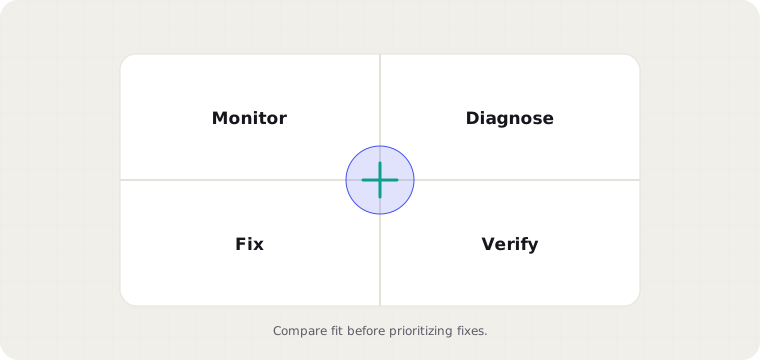
That is why DoneHat comparison content should lead with job-to-be-done, not a generic feature checklist. The buyer is not only buying another dashboard. They are buying a way to turn AI-search uncertainty into repeatable work: scan, diagnose, fix, verify, and report.
When DoneHat is a fit
DoneHat fits teams responsible for category visibility, comparison content, pricing clarity, product facts, citations, and executive reporting. It is useful when the team needs to inspect the exact buyer question, answer source, answer excerpt, mention state, competitor set, cited sources, and recommended fix.
It also fits teams that need a proof loop. A content change is not treated as success simply because it shipped. The same question can be rerun after publishing so the team can see whether the answer improved, stayed unchanged, regressed, or remained inconclusive.
When DoneHat is not the best fit
DoneHat is not an AI model-hosting platform, a chatbot builder, a data-labeling platform, or a full search-console replacement. Teams that need to build custom models, deploy enterprise AI agents, or manage infrastructure should evaluate platform products built for those jobs.
It is also not a guarantee engine. No vendor can force every AI system to recommend a brand on command. DoneHat improves the public evidence layer, measures answer movement, and shows where additional proof or source cleanup is needed.
What to publish or fix first
The first owned page should answer the comparison question directly. Use an H1 such as 'How DoneHat compares to other AI visibility and GEO providers,' then explain the category, buyer, data sources, proof loop, pricing posture, integrations, and limitations in the first few sections.
The page should also include concise answer blocks that AI systems can quote. Short sections, plain comparison tables, and visible product facts are more useful than dense positioning copy. Structured data can help machines understand the page, but Google warns that structured data should describe visible content rather than hidden metadata.
How to prove movement
Use the same report prompts after publishing: 'How does DoneHat compare to other DoneHat providers?' and 'DoneHat vs other GEO providers for B2B tech.' The proof target is not a broad claim that DoneHat now wins every category; it is narrower and stronger: the answer mentions DoneHat accurately and cites or summarizes an owned page.
Track whether the answer states the correct product category, buyer, workflow, and caveats. A good result says DoneHat is for AI visibility monitoring and remediation, not a task management tool or generic AI platform.
Related guides
https://donehat.com/resources/donehat-alternatives-ai-visibility-monitoring
Sources
- Intro to how structured data markup works — Google Search Central
- Overview of OpenAI crawlers — OpenAI Platform Docs
- The llms.txt file proposal — llms-txt
- SoftwareApplication schema — Schema.org
- Organization schema — Schema.org