
Before-and-after proof playbook: how to show that an AI visibility fix actually worked
A practical guide for proving impact without turning a single answer into an exaggerated claim.
Who this guide is for
Growth, SEO, and agency delivery teams
Define the change before you ship
A proof check starts before the fix goes live. Write down what you expect to improve: mention state, answer position, cited source quality, competitor framing, factual accuracy, or clarity of buyer fit. This prevents teams from claiming victory based on a vague sense that the answer looks better.
Good proof criteria are observable. 'AI understands us better' is too broad. 'The brand appears in the top three recommendations for this buyer question and the answer cites our comparison page' is specific enough to evaluate.
Keep the comparison narrow
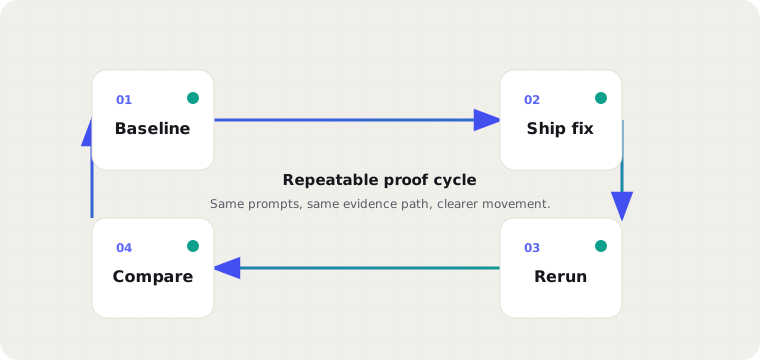
A before-and-after view should compare the same buyer question, the same answer source, and the same issue when possible. That keeps the proof focused on whether the fix changed the measured answer.
Do not overextend the claim. If one answer improved, say that the measured answer improved. If many answer checks improved across sources and question groups, then the report can make a broader claim. The scope of the statement should match the scope of the evidence.
Record the original state clearly
The original state should capture the buyer question, answer source, answer excerpt, brand mention state, competitor mentions, cited sources, and the relevant timestamp. Without that record, the after state has nothing defensible to compare against.
For stakeholders, the original state is often the most persuasive part of the story. It shows the business problem in the buyer's own language: a prospect asked for help, and the answer did not include the brand or described it incorrectly.
Connect the fix to a root cause
Proof is stronger when the fix is tied to a root cause. If the brand was absent because the product page did not explain the use case, the fix should make that use case explicit. If the issue came from stale pricing, the fix should update the owned page and the stale public source where possible.
A fix that is not tied to root cause may still work, but it is harder to defend. The best reports show the chain: issue, likely reason, shipped change, proof result, and next action.
Use outcome labels that executives understand
Use labels such as improved, unchanged, regressed, and inconclusive. They are simple, but they cover the real possibilities. Do not force every result into a win. Inconclusive is a useful outcome when the answer changed but the brand outcome did not clearly improve.
When a result is unchanged, turn it into learning. It may mean the source has not been picked up yet, the page is too weak, the third-party evidence is missing, or the buyer question is dominated by a competitor with stronger public proof.
Report movement and evidence together
A movement metric without evidence feels abstract. Evidence without movement is hard to summarize. Use both. Show that mention rate changed, but also show the answer excerpt and cited sources that explain the change.
For agency reporting, this is especially important. Clients need to see the work shipped and the answer change. Screenshots alone are brittle. A structured before-and-after report gives the account team something repeatable.
Account for timing
Some answer sources update quickly through live retrieval. Others depend on slower indexes or model-side behavior. A proof check that is unchanged one day after publishing may become improved later, but that should not be assumed.
Set a cadence for follow-up. For high-impact fixes, run an initial proof check, then repeat after enough time has passed for public pages and third-party sources to be discovered. Keep the result history so teams can see whether the effect arrived later.
Build the reporting habit
Proof checks should feed a weekly narrative: what was fixed, what improved, what regressed, what remained unchanged, and what the next root cause is. This keeps AI visibility out of the realm of anecdotes.
The teams that win are not the teams that produce the most content. They are the teams that connect answer evidence to fixes, fixes to proof, and proof to the next investment decision.