
The AI answer content system: how to make your brand easier to mention, cite, and recommend
A detailed operating model for building pages, facts, structured data, and third-party proof that AI answer systems can use.
Who this guide is for
SEO, product marketing, and content teams
Think in answer readiness, not page volume
Publishing more pages is not the same as becoming easier for AI systems to recommend. Answer readiness means your public footprint clearly explains who you serve, what problem you solve, what you replace, what you integrate with, how you are priced, and why buyers should trust you.
A thin article can rank for a keyword and still fail inside an AI answer. The answer system needs concise facts, supporting proof, recent sources, and a clear relationship between the buyer's question and the brand's capabilities.
Build around the questions buyers actually ask
Start with buyer questions that represent real evaluation behavior: category shortlists, alternatives, competitor comparisons, use cases, pricing fit, integration needs, regional requirements, and objections. These questions reveal how buyers ask for help before they visit a vendor site.
Do not treat buyer questions as keywords with extra words. The structure is different. Buyers ask for judgment, tradeoffs, recommendations, and fit. Your content should answer those needs directly, not just repeat high-volume phrases.
Create a source-of-truth layer for facts
Every brand needs a maintained set of approved facts: one-liner, target customer, product category, pricing model, key differentiators, integrations, proof points, and forbidden claims. This is the layer that keeps drafted work from drifting into vague or unsupported language.
The source-of-truth layer should be specific enough to use in copy and cautious enough to prevent overclaiming. A statement such as 'best for all teams' is weak. A statement such as 'built for distributed B2B teams that need async project visibility and lightweight approvals' gives answer systems a clearer retrieval target.
Design pages that answer systems can quote
Pages that work well in AI answers are usually direct, structured, and evidence-rich. They use descriptive headings, short answer blocks, comparison tables, FAQ sections, product facts, schema where appropriate, and links to supporting sources.
The goal is not to write for a robot. The goal is to make useful claims easy to retrieve and hard to misread. If a human skimming the page cannot quickly understand buyer fit, price posture, and proof, an answer system will probably struggle too.
Use third-party proof deliberately
Owned pages are necessary, but they are rarely enough for competitive categories. AI answers often lean on review sites, directories, community discussions, comparison articles, documentation, and public profiles. If competitors have stronger third-party proof, they can win even when your owned content is better.
Map the sources that answer systems cite. Then decide whether the fix is better owned content, updated third-party listings, fresher reviews, industry mentions, documentation improvements, or public proof that connects your brand to the category.
Prioritize pages by answer impact
A good content queue is ordered by impact. Fix pages that support missing mentions, competitor dominance, inaccurate claims, and high-intent comparison questions before polishing lower-risk areas. The best first fix often touches a product page, comparison page, pricing page, FAQ section, or proof page.
A page earns priority when it can change how the brand is represented in a high-intent answer. Traffic alone is not enough. The page must help answer systems understand a buyer decision.
Measure after publishing
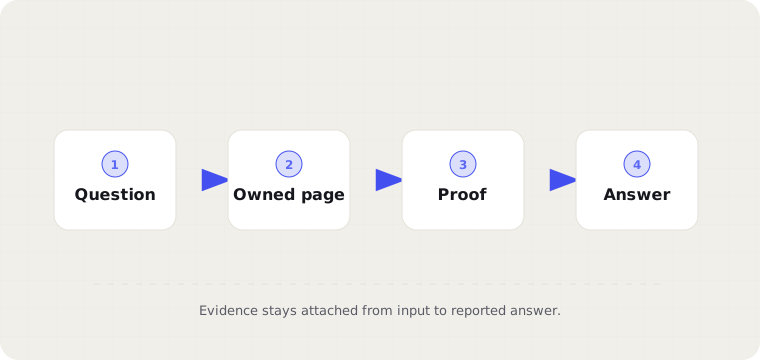
After a fix ships, wait long enough for live retrieval and indexes to see the change, then run a proof check. Repeat the same buyer question, inspect the answer, and compare mention state, position, citations, and claim accuracy.
If the answer improves, document the fix and add it to the reporting narrative. If it does not, inspect whether the content is crawlable, whether the claim is specific, whether supporting sources exist, and whether the buyer question needs a different page type.
Turn the system into a weekly habit
AI visibility improves fastest when the team treats it as an operating rhythm: scan, triage, fix, publish, prove, report. A weekly review is usually enough for most teams, with more frequent checks during launches, repositioning, pricing changes, or competitive pushes.
The content system compounds. Each approved fact, fixed page, improved source, and proven answer becomes part of a stronger public footprint. Over time, the brand becomes easier to mention, cite, and recommend.