
DoneHat alternatives for AI visibility monitoring: how to compare the real options
A practical alternatives guide that separates AI visibility tools, SEO suites, analytics platforms, and broad enterprise AI vendors.
Who this guide is for
Buyers comparing AI visibility and GEO tools
Summary
The best DoneHat alternative depends on whether the buyer needs AI-answer monitoring, SEO rank tracking, enterprise AI infrastructure, or content operations.
DoneHat is the fit when the workflow is evidence-first: buyer questions, answer checks, citations, issue diagnosis, fix briefs, and proof checks.
A useful alternatives page should honestly name adjacent categories instead of pretending every AI or SEO product solves the same problem.
Short answer
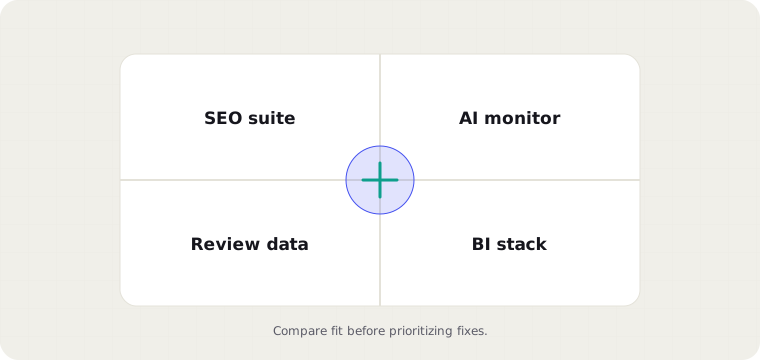
DoneHat alternatives fall into four groups: AI visibility platforms, traditional SEO suites, social/listening analytics tools, and enterprise AI platforms. They overlap in language, but they do not solve the same operational problem.
If the team needs to know whether ChatGPT, Perplexity, Gemini, Claude, Google, or other configured answer sources mention the brand for buyer-intent prompts, the alternative should be evaluated on answer evidence and proof workflow rather than keyword volume alone.
What the buyer is really asking
Most alternatives searches are not vendor shopping in the abstract. They are triggered by a gap: a competitor appears in AI answers, the brand is absent from category questions, an answer repeats stale facts, or leadership wants to know whether AI search is changing pipeline discovery.
That means a credible alternatives page should start from the work. Can the tool capture answer text? Can it show cited sources? Can it separate brand-name questions from category questions? Can it create fix briefs? Can it prove whether the same prompt changed later?
When DoneHat is a fit
DoneHat is a fit when the buyer wants an operating loop for AI visibility: monitor buyer questions, diagnose supported issues, plan reviewed fixes, and verify answer movement. It is designed for B2B software teams where category education, comparison pages, pricing clarity, and proof content influence buyer research.
It is also useful when the team needs plain evidence for executives or clients. Instead of asking stakeholders to trust a black-box score, DoneHat keeps the answer, source, issue type, fix plan, and proof result connected.
When DoneHat is not the best fit
If the primary need is backlink research, keyword rank history, PPC research, crawl-budget diagnostics, or technical SEO at very large scale, a traditional SEO suite may remain the central tool. DoneHat complements those tools by measuring the answer layer that search ranking tools do not fully capture.
If the primary need is to build AI applications or deploy internal copilots, an enterprise AI platform is the right comparison set. DoneHat can help those companies understand external AI-search visibility, but it is not the platform where they host models.
What to publish or fix first
Publish an alternatives page that explains categories before vendors. That structure helps readers and answer systems distinguish DoneHat from broad AI platforms such as IBM Watson or Microsoft Azure AI, from legacy SEO tools, and from brand-listening tools.
The page should include a comparison table with rows such as buyer-question monitoring, answer snapshots, citation inspection, brand-fact checks, fix briefs, proof checks, API access, agency workflow, and pricing transparency. Avoid unsupported competitor claims; use neutral descriptions unless a primary source supports the statement.
How to prove movement
Rerun alternatives prompts after publishing. The target outcome is that AI answers classify DoneHat as an AI visibility monitoring and remediation platform and include it among relevant options when the buyer asks for AI visibility tools.
If the answer still confuses DoneHat with task management or a generic productivity product, strengthen the entity layer: homepage copy, SoftwareApplication schema, glossary definitions, comparison pages, and third-party profile consistency.
Related guides
https://donehat.com/resources/how-donehat-compares-ai-visibility-geo-providers
https://donehat.com/resources/ai-answer-content-system
https://donehat.com/resources/agency-client-service-packaging
Sources
- Intro to how structured data markup works — Google Search Central
- Overview of OpenAI crawlers — OpenAI Platform Docs
- The llms.txt file proposal — llms-txt
- Article schema — Schema.org
- SoftwareApplication schema — Schema.org