
Agency client service packaging: how to sell and operate AI visibility without screenshots
A very detailed service model for agencies that want recurring AI visibility revenue with measurable deliverables.
Who this guide is for
Agencies and consultants
Package the service around outcomes
Clients do not buy answer checks. They buy a clearer view of how buyers encounter the brand inside AI search and answer systems. Package the service around current-state visibility, competitive risk, fixed issues, and before-and-after proof.
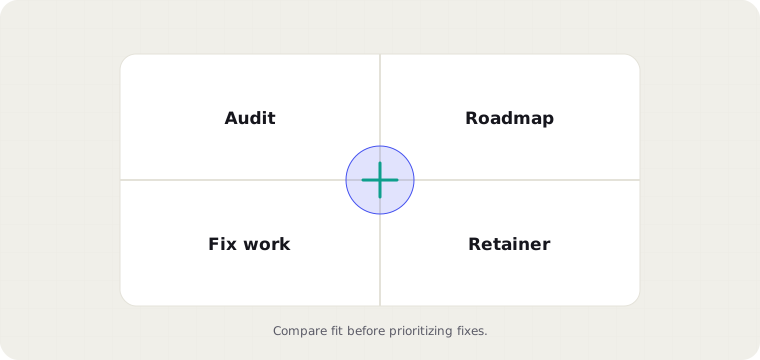
A simple service line has four deliverables: a current-state audit, recurring visibility scans, a prioritized fix plan, and proof reporting. This is easy to explain, easy to renew, and easier to defend than a one-time screenshot deck.
Create one brand account per client
Each client should have a separate brand account with its own brand facts, competitors, buyer questions, reports, integrations, and team activity. This keeps reporting clean and protects client data boundaries.
For agencies, separation also improves operations. Account managers can review only their clients, strategists can compare patterns across accounts, and executives can see which accounts have the highest-risk issues.
Use a standard monthly cadence
A durable cadence is simple: scan at the start of the period, triage issues, approve fixes, ship content or technical updates, run proof checks, and package the results. The same cadence can serve SEO retainers, content retainers, and AI visibility add-ons.
Do not let every client invent a unique process. Keep the core delivery model consistent, then vary the buyer questions, sources, competitors, and fix priorities by client category.
Write deliverables in client language
A client deliverable should say what answer changed and why it matters. Avoid implementation terms unless the client specifically needs them. A strategy stakeholder wants to know that buyers asking a high-intent question now see the brand with stronger proof.
Use phrases such as 'buyer question,' 'answer source,' 'fix,' 'proof check,' and 'confidence range.' This language makes the service feel like measurement and consulting, not like an engineering console.
Assign work by owner type
Most fix plans touch multiple disciplines. Content strategists own comparison pages and FAQ sections. Technical SEOs own structured data, crawlability, and page hygiene. Account managers own client approval and reporting. Leadership owns tradeoffs when fixes require larger positioning decisions.
Done well, AI visibility becomes a cross-functional operating rhythm. The agency is not merely reporting a problem; it is coordinating the steps that can change how the market hears about the client.
Use proof reporting as the renewal engine
The easiest service to renew is the one that can show movement. Proof reports should show the original answer, the fix shipped, the new answer, and the interpretation. Even unchanged results help, because they explain what the next fix should address.
A client does not need every answer check. They need the highest-impact movements, regressions, unresolved risks, and work completed. Make the report concise at the top and evidence-rich underneath.
Protect against overpromising
Agencies should be clear that no vendor can force every AI system to recommend a brand on command. The service improves the public evidence answer systems can use and measures whether answers changed in the observed window.
That honesty is a strength. It makes the service credible and creates a reason for ongoing work: visibility is monitored, issues are found, fixes are shipped, and proof is collected as systems and competitors change.
Build a premium tier
A premium tier can include deeper competitor tracking, more frequent scans, regional question sets, source cleanup, structured-data implementation, executive reporting, and integration with client dashboards.
The premium story is not 'more data.' It is faster detection, stronger fixes, tighter proof, and clearer executive reporting. That is what makes AI visibility a managed service instead of a novelty audit.