
SEO vs GEO vs AEO: a practical guide for teams building AI search visibility
A plain-language guide to how classic SEO, generative engine optimization, and answer engine optimization fit together.
Who this guide is for
SEO teams, founders, agencies, and executives
Summary
SEO, GEO, and AEO overlap: useful crawlable content, clear structure, and trustworthy sources still matter.
GEO and AEO add a sharper focus on answer construction, buyer questions, citations, and proof checks.
DoneHat helps teams operate the shared loop: measure answers, diagnose gaps, ship fixes, and verify movement.
Short answer
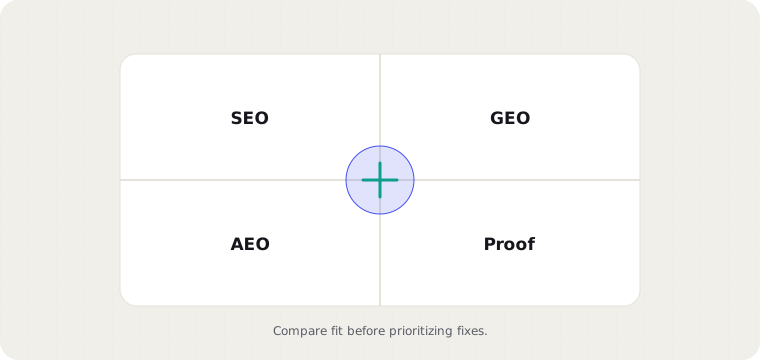
SEO helps pages be found in search. GEO focuses on how generative answer systems understand and recommend a brand. AEO focuses on content that directly answers questions. In practice, strong teams operate them together instead of treating them as separate silos.
DoneHat is built for the part classic SEO tools often miss: what AI answers actually say about the brand when buyers ask category, comparison, pricing, API, proof, or regional questions.
What the buyer is really asking
When someone asks whether SEO is different from GEO or AEO, they usually want to know what work should change. The answer is not to abandon SEO. Google's own guidance says SEO remains relevant for generative AI search because those features still depend on crawlable, helpful, high-quality content and search systems.
What changes is the unit of analysis. Instead of only watching keywords and rankings, teams also monitor buyer questions, answer text, citations, competitor mentions, source quality, and proof after fixes.
When DoneHat is a fit
DoneHat is a fit when SEO already owns category education, comparison pages, content briefs, schema, technical hygiene, and reporting. It gives that team an answer-engine layer without forcing them to abandon existing SEO tools.
It also fits agencies that want to package AI visibility as a service: audit, monitor, fix, verify, and report across multiple client brands.
When DoneHat is not the best fit
DoneHat does not replace crawling, rank tracking, backlink research, log analysis, or analytics. Those remain useful parts of the search stack.
It is also not an excuse to publish low-quality pages for every possible prompt variation. Google warns against scaled content created primarily to manipulate rankings or generative answers; the better strategy is fewer, stronger pages that satisfy real users.
What to publish or fix first
Start with high-intent answer surfaces: category pages, comparison pages, alternatives pages, pricing/procurement pages, API/integration pages, multilingual/regional pages, proof pages, and trust pages.
Each page should answer the buyer's question directly, support the claim with visible evidence, connect to related pages, and use structured data only where it accurately describes visible content.
How to prove movement
Use classic SEO metrics and AI answer metrics together. Search Console can show search impressions and clicks; DoneHat can show whether AI answers mention the brand, cite the page, and describe the product accurately.
Proof is strongest when both layers move in the right direction, but they may not move at the same time. Treat AI visibility as a measured operating rhythm rather than a one-time launch task.
Related guides
https://donehat.com/resources/multilingual-seo-ai-visibility-tools
https://donehat.com/resources/ai-share-of-voice-measurement
https://donehat.com/resources/llm-citation-readiness-checklist
Sources
- Optimizing your website for generative AI features on Google Search — Google Search Central
- Intro to how structured data markup works — Google Search Central
- Build and submit a sitemap — Google Search Central
- Article schema — Schema.org
- SoftwareApplication schema — Schema.org