
LLM citation readiness checklist: make pages easier for AI answers to quote and trust
A page-level checklist for writing content that AI answer systems can retrieve, summarize, cite, and verify.
Who this guide is for
Content strategists, technical SEOs, and product marketers
Summary
LLM citation readiness means a page visibly supports the answer an AI system might give.
The strongest pages combine direct answers, short sections, structured facts, internal links, schema where appropriate, and external proof.
DoneHat uses citeability and proof checks to show whether page changes improve answer mentions and source usage.
Short answer
A page is LLM-citation ready when it directly answers a buyer question and visibly supports the claims an answer system may reuse. The page should be specific, crawlable, well structured, and connected to supporting evidence.
DoneHat turns this into a workflow by identifying missed prompts, recommending page-level fixes, and rerunning the same questions after publishing to see whether answer systems cite or summarize the improved page.
What the buyer is really asking
A buyer does not care whether a page is optimized for a crawler. They care whether the answer is clear, trustworthy, and useful. LLM citation readiness is the technical/content discipline behind that human outcome.
The page should answer one main question first, then support the answer with product facts, examples, limitations, links, schema, and proof. Avoid long intros that delay the answer.
When DoneHat is a fit
DoneHat is a fit when teams need to know which pages are too vague for AI answers to reuse. A citeability issue can point to missing headings, buried claims, thin FAQs, absent schema, weak internal links, or missing proof.
It is also useful for content governance. Drafted fixes can be checked against brand facts so the team improves citation readiness without introducing unsupported claims.
When DoneHat is not the best fit
DoneHat does not replace editorial judgment. A page can be technically tidy and still fail if it lacks a meaningful point of view, customer proof, or clear buyer relevance.
It also cannot guarantee citation. Search and answer systems decide what to retrieve and cite. DoneHat narrows the work to fixes that make citation more plausible and measurable.
What to publish or fix first
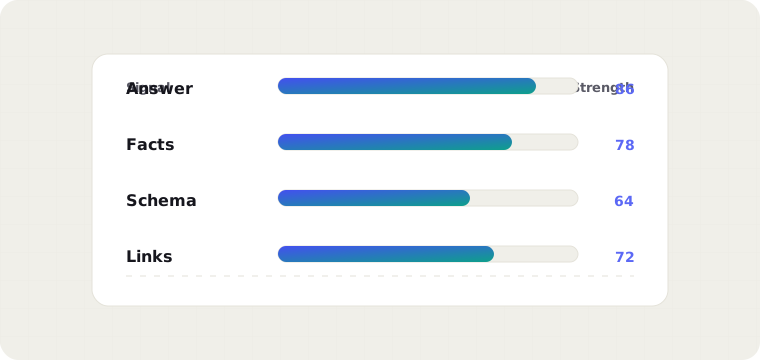
Use this checklist: direct H1, answer-first paragraph, descriptive H2s, short paragraphs, visible product facts, comparison table where relevant, FAQ only when visible, source links, internal links, and JSON-LD that matches page content.
For DoneHat's own site, priority pages include comparison, alternatives, API integrations, transparent pricing, multilingual SEO, proof signals, and the homepage entity summary.
How to prove movement
Before publishing, record the missed prompt and current answer. After publishing, rerun the same prompt and inspect mention state, answer accuracy, source usage, and competitor framing.
A page-level proof check is successful when the answer uses the new page accurately, cites the right source, or changes from absent to mentioned for the target prompt.
Related guides
https://donehat.com/resources/ai-answer-content-system
https://donehat.com/resources/chatgpt-brand-visibility-guide
https://donehat.com/resources/perplexity-ai-visibility-citation-guide
Sources
- Optimizing your website for generative AI features on Google Search — Google Search Central
- Intro to how structured data markup works — Google Search Central
- FAQPage structured data guidance — Google Search Central
- The llms.txt file proposal — llms-txt
- Article schema — Schema.org
- WebSite schema — Schema.org