
AI share of voice measurement: how to report brand visibility without overclaiming
A measurement guide for comparing brand mentions, competitors, confidence ranges, and prompt groups in AI answers.
Who this guide is for
Growth leaders, analysts, and executive operators
Summary
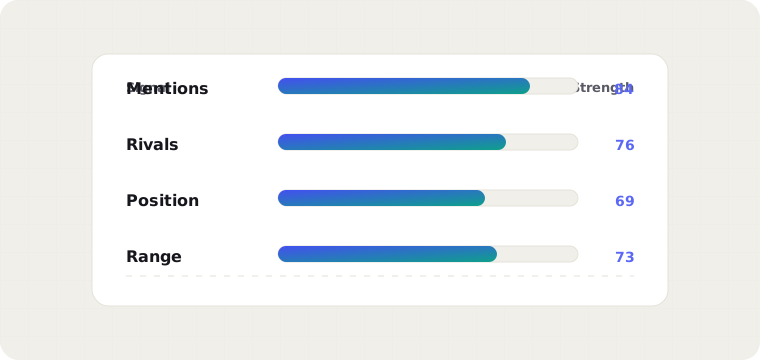
AI share of voice is a sampled measurement of how often a brand appears relative to competitors for the same buyer questions.
The metric is useful only when paired with prompt mix, answer sources, confidence range, sample size, and answer evidence.
DoneHat reports should separate brand-name prompts from category, comparison, pricing, and proof prompts so teams know what actually moved.
Short answer
AI share of voice measures how often a brand appears in sampled AI answers compared with competitors for the same buyer questions. It is not the same as market share, search traffic, or permanent ranking.
DoneHat should report AI share of voice with the evidence path attached: question group, answer source, mention state, competitor mentions, confidence range, cited sources, and timestamp.
What the buyer is really asking
Executives want to know whether AI search is helping or hurting brand discovery. A single score can summarize direction, but it can also mislead if it hides the prompt mix. Brand-name prompts are easier than category or comparison prompts.
A useful report separates category discovery, competitive alternatives, direct comparison, pricing/procurement, API/integration, regional, and proof/review questions. That separation shows where the brand is strong and where content or proof is missing.
When DoneHat is a fit
DoneHat is a fit when the team needs a repeatable answer-level measurement system rather than occasional manual checks. It tracks answer evidence and issue history so teams can see whether content fixes changed the measured answers.
It is also useful for agency and executive reporting because the metric can be explained without exposing implementation details. Stakeholders can see what was asked, what answered, which competitor appeared, and what changed after the fix.
When DoneHat is not the best fit
DoneHat should not be used to imply total market share from a small prompt sample. A sampled AI visibility score is directional unless the sample design, repeat checks, and confidence range support stronger claims.
It also should not replace funnel reporting. AI share of voice helps explain discovery risk, while analytics and CRM systems explain downstream conversion behavior.
What to publish or fix first
Fix the lowest-performing high-intent prompt group first. If comparison questions miss the brand, publish comparison pages. If pricing questions miss the brand, clarify pricing posture. If proof questions miss the brand, strengthen reviews, case studies, trust pages, and third-party references.
The report should name the first fix and the proof prompt before work starts. That keeps the team from shipping generic content that cannot be evaluated.
How to prove movement
Use before/after checks on the same prompt group. A clean proof result says the brand moved from absent to mentioned, weak mention to stronger mention, uncited to cited, inaccurate to accurate, or competitor-dominated to more balanced.
If the score moves but evidence does not support a useful buyer outcome, do not overclaim. The narrative should explain what changed, what stayed uncertain, and what the next fix should address.
Related guides
https://donehat.com/resources/board-ready-ai-visibility-reporting
https://donehat.com/resources/executive-ai-visibility-operating-rhythm
Sources
- Optimizing your website for generative AI features on Google Search — Google Search Central
- Intro to how structured data markup works — Google Search Central
- Article schema — Schema.org
- DoneHat AI answer comparisons — DoneHat