
Executive operating rhythm for AI visibility: weekly review, monthly reporting, quarterly strategy
A long guide for leaders who want AI visibility to become a durable business process instead of a one-off audit.
Who this guide is for
Executives, operators, and team leads
Make AI visibility an operating rhythm
AI visibility changes as answer systems, public sources, competitors, and your own site change. A one-time audit is useful, but it is not enough for categories where buyers actively compare vendors through AI search.
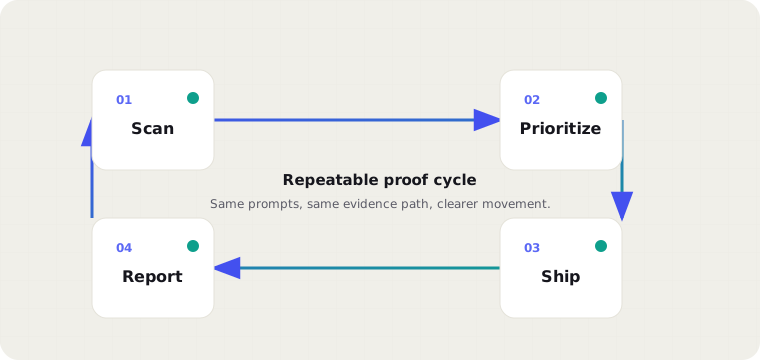
A durable rhythm has three layers: weekly operating review, monthly executive reporting, and quarterly strategy. Each layer uses the same evidence, but at a different level of detail.
Run a focused weekly review
The weekly review should answer five questions: What changed? What is newly risky? Which fixes shipped? Which proof checks improved? Which unresolved issue needs a decision? Keep the meeting short and evidence-led.
The team should avoid reading every answer together. Instead, review the highest-impact changes and assign next actions. The purpose is momentum, not analysis theater.
Create a monthly executive report
The monthly report should summarize score movement, competitor movement, top buyer questions, critical inaccuracies, fixes shipped, proof results, and limitations. It should be possible to read the report in five minutes and inspect evidence if needed.
Executives need trends and decisions. They do not need implementation detail. Keep terms customer-facing, show confidence responsibly, and connect every recommendation to business impact.
Use quarterly strategy to change the market footprint
Quarterly planning should look beyond individual fixes. It should ask whether the brand has enough public proof for the category, whether regional markets need dedicated content, whether competitor comparisons are clear, and whether third-party sources need attention.
This is where AI visibility becomes more than a reporting function. It informs content strategy, PR, partnerships, review generation, product marketing, documentation, and launch planning.
Assign owners by decision type
Not every issue belongs to SEO. Pricing inaccuracies may need product marketing. Unsupported claims may need communications or legal review. Structured-data gaps may need technical SEO. Third-party proof gaps may need partnerships, customer marketing, or PR.
A strong operating rhythm routes work to the right owner quickly. The report should make ownership clear so issues do not sit in a generic queue.
Protect trust with limitations
Every recurring report should include limitations: sample size, answer sources checked, confidence range, recent source failures, and whether results are directional or deep enough for stronger claims. This keeps the program credible as it scales.
Leaders do not need perfect certainty. They need consistent measurement, visible assumptions, and a practical way to improve. A clear limitation section helps them decide how much weight to place on each result.
Tie investment to answer movement
AI visibility investment should be tied to changes in buyer-facing answers. If a comparison page improves multiple high-intent answers, it deserves continued investment. If a fix does not move an answer, inspect the root cause before doing more of the same.
This creates a healthier content culture. Teams stop measuring only publication volume and start measuring whether buyers receive better, more accurate recommendations.
Build a shared language
The organization should use a shared language: buyer questions, answer sources, visibility scan, answer checks, issue, fix plan, proof check, confidence range, and source quality. Shared language makes cross-functional work faster.
When the language is clear, AI visibility stops feeling experimental. It becomes a repeatable measurement and improvement loop that teams can understand, defend, and run every week.