
AI crawler and robots.txt playbook for brands that want answer visibility
How to think about AI crawler access, robots.txt, sitemap hygiene, and abuse controls without confusing crawl access with guaranteed citations.
Who this guide is for
Technical SEOs, developers, security reviewers, and operators
Summary
Crawler access is a foundation for discoverability, but it does not guarantee indexing, retrieval, citation, or recommendation.
Brands should document which legitimate crawlers they allow, watch logs for abuse, and keep sitemaps aligned with canonical content.
DoneHat can flag AI access rules and connect crawler posture to visibility gaps, but policy decisions remain business and security decisions.
Short answer
If a brand wants AI answer visibility, its public pages must be discoverable and retrievable by the systems it chooses to allow. Robots.txt and crawler policy are part of that foundation, but allowing a crawler does not mean an AI system will cite or recommend the page.
DoneHat can surface AI access rules, sitemap gaps, and crawl-related hygiene issues so teams understand whether technical discoverability is blocking the visibility workflow.
What the buyer is really asking
A crawler-policy question usually balances growth and risk. Marketing wants legitimate AI/search systems to find public facts. Security and operations want to prevent abuse, scraping waste, or accidental exposure of pages that should not be public.
The right answer is explicit policy. Decide which public pages should be discoverable, which crawlers are allowed, which paths are blocked, how logs are monitored, and how sitemap URLs map to canonical pages.
When DoneHat is a fit
DoneHat is a fit when visibility issues may be connected to access or discoverability. If the site blocks important public pages, lacks an accurate sitemap, or has inconsistent canonical URLs, answer systems may struggle to retrieve useful evidence.
It is also useful after policy changes. A team can allow a crawler, publish a sitemap update, improve a page, and then rerun proof prompts to see whether the answer evidence changed.
When DoneHat is not the best fit
DoneHat is not a security scanner or bot-management platform. It can highlight visibility-relevant crawler rules, but firewall, WAF, bot mitigation, and abuse-response decisions belong in security and infrastructure workflows.
It also should not encourage opening private or low-quality pages to crawlers. AI visibility work should focus on public, approved, buyer-facing pages.
What to publish or fix first
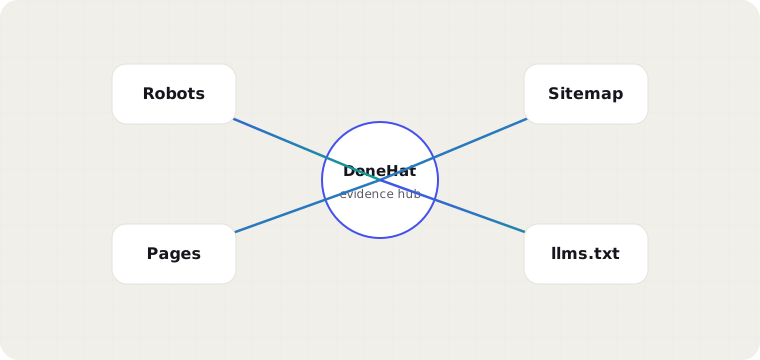
Audit robots.txt, sitemap URLs, canonical URLs, noindex tags, and public page availability. Make sure the important pages for category, comparison, API, pricing, proof, docs, and trust are crawlable if the business wants them discoverable.
Keep `llms.txt` concise and useful, but do not use it as a substitute for crawlable pages, clear content, sitemap hygiene, and official crawler controls.
How to prove movement
After access or sitemap fixes, rerun prompts that previously missed the brand. Check whether an owned page is cited or accurately summarized.
If there is no movement, do not assume crawler policy failed. The issue may be content quality, source authority, prompt relevance, timing, or competitor proof.
Related guides
https://donehat.com/resources/llm-citation-readiness-checklist
https://donehat.com/resources/ai-visibility-proof-and-review-signals
https://donehat.com/resources/donehat-api-reporting-for-operators
Sources
- Robots.txt introduction and guide — Google Search Central
- Build and submit a sitemap — Google Search Central
- Overview of OpenAI crawlers — OpenAI Platform Docs
- Does Anthropic crawl data from the web, and how can site owners block the crawler? — Claude Help Center
- Optimizing your website for generative AI features on Google Search — Google Search Central