
Regional AI visibility playbook: how to measure local buyer answers without global bias
A detailed playbook for brands that sell in specific countries, cities, languages, or regional categories.
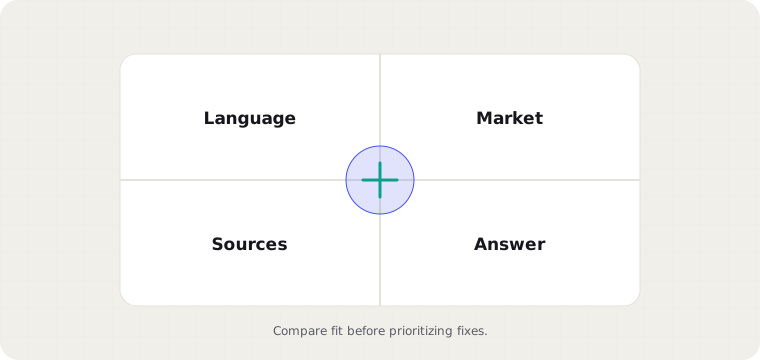
Who this guide is for
Regional marketers, local agencies, and international teams
Global answers can hide regional risk
A brand can look strong in a generic global answer and still be absent when buyers ask from a regional perspective. Local competitors, language choices, regulatory requirements, directories, and country-specific sources can change the answer dramatically.
Regional visibility matters for SaaS, services, marketplaces, agencies, financial tools, education, healthcare, and any category where buyer trust depends on local context. A global score alone is often too blunt for these markets.
Localize the buyer questions
Regional buyer questions should include the country, city, language, market segment, and buyer constraint where relevant. For example, a buyer may ask for tools in Germany, agencies in Dhaka, payroll software for UK businesses, or privacy-friendly analytics in the EU.
Do not simply translate global questions. Regional buyers often use different category names, compliance language, price expectations, and competitor references. Build the question set from real search data, sales calls, local competitor pages, and regional source patterns.
Separate local and global competitors
A strong regional report separates local competitors from global players. This matters because a buyer may see global brands in one part of the answer and local alternatives in another. The fix strategy differs depending on which group is winning.
Local competitors may win through directories, local reviews, language-specific content, partnerships, and regional proof. Global competitors may win through brand authority and broad third-party coverage. The report should make this distinction visible.
Inspect regional sources
Regional answer systems often cite local directories, government pages, trade publications, review sites, partner pages, and community discussions. If the brand is missing from those sources, owned content alone may not be enough.
Source inspection helps teams avoid guessing. If AI answers cite a local directory, update or earn placement there. If they cite a regional comparison page, understand why competitors are included and whether your brand has a credible path into that source set.
Make language part of the fix plan
If buyers ask in a local language, the fix plan should include local-language pages or sections. Machine-translated copy is rarely enough. The page should use the language buyers use for categories, features, proof, pricing, and objections.
Language also affects confidence. A brand may be known globally but fail regional questions because the relevant evidence is only available in English. Localized proof can materially improve answer quality.
Account for market claims
Regional markets often have specific legal, compliance, or trust requirements. If the answer claims a brand supports a regulation, tax rule, data residency need, or local payment method, that claim should be verified against public facts.
Inaccurate regional claims can be more damaging than a missing mention because they create buyer confusion. The report should flag them clearly and route them into the fix plan with the right owner.
Report region-specific movement
After regional fixes ship, repeat the same local buyer questions and inspect whether the answer changed. Track movement separately from global visibility so the team does not bury local progress inside a broad average.
For international teams, this creates a portfolio view: which regions are improving, which have source gaps, which need localization, and which competitors dominate specific local answers.
Use regional visibility as a growth signal
Regional AI visibility can reveal where the brand has market pull and where public proof is thin. If buyers in one country consistently see the brand and buyers in another do not, that is useful input for market expansion, content investment, partnerships, and PR.
The goal is to make AI visibility specific enough to drive action. Region, language, competitor type, and source quality are the difference between a generic score and a useful growth signal.