
Brand facts source of truth: how to stop AI answers from repeating stale or unsupported claims
A deep guide to building the factual layer that keeps AI answers, content fixes, and proof checks grounded.
Who this guide is for
Product marketing, brand, and communications teams
Treat facts as infrastructure
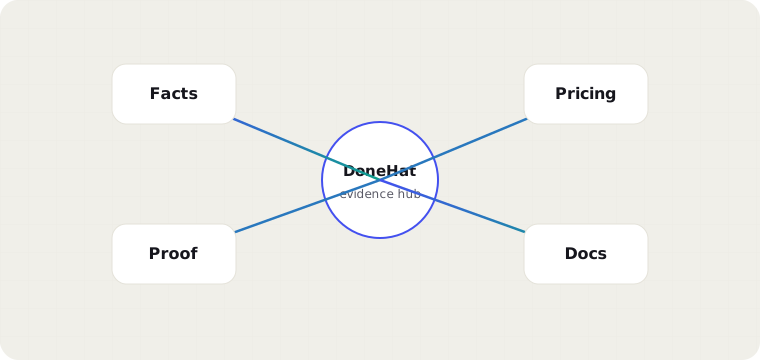
Brand facts are not a form field exercise. They are infrastructure for how the product is described, compared, cited, and corrected. If the facts are vague, the content system becomes vague. If the facts are stale, AI answers can repeat stale information.
The minimum fact set should include the brand one-liner, target customer, product category, pricing posture, supported use cases, integrations, differentiators, proof points, and forbidden claims. Each item should be written in language a buyer would understand.
Create forbidden-claim rules
A forbidden claim is something the brand should not say or allow drafted content to imply. Examples include unsupported market leadership, outdated pricing, deprecated features, legal claims, or customer-fit claims that are too broad.
Forbidden claims protect trust. They keep the fix plan from introducing a new risk while trying to solve an old one. They also help reviewers quickly decide whether a recommendation is safe to use.
Add proof next to every meaningful claim
Strong facts have supporting proof. A proof point can be a customer count, review score, certification, integration partner, case study, analyst mention, public benchmark, or documented feature. The point is to connect the claim to something answer systems can cite or corroborate.
If a fact has no proof, treat it as lower confidence. It may still be useful positioning, but the report should distinguish between owned claims and claims with stronger public support.
Align facts to buyer questions
Facts are most useful when they map to buyer questions. If buyers ask about alternatives, the brand facts should define what makes the product different. If buyers ask about pricing fit, the pricing posture should be explicit. If buyers ask about integrations, the supported ecosystem should be clear.
This mapping turns a generic brand profile into an answer-ready knowledge layer. It helps teams identify which facts are missing from public pages and which pages need clearer language.
Clean up public inconsistency
AI answers can pull from stale directories, old reviews, outdated blog posts, cached pages, and old press mentions. If those sources contradict current brand facts, the answer may repeat the stale version even after the owned site is fixed.
Source cleanup is part of the fix plan. Update public profiles, request corrections where possible, add current proof, and make sure owned pages state the current facts directly. The goal is to reduce ambiguity across the public web.
Use facts in review workflows
Every drafted content fix should be reviewed against brand facts before publication. Reviewers should ask whether the draft uses approved positioning, avoids forbidden claims, cites valid proof, and answers the buyer question without inflating the claim.
This review does not need to slow the team down. A clear fact layer makes approval faster because reviewers are not re-litigating the brand's position on every fix.
Update facts after product changes
Pricing changes, new integrations, repositioning, launches, regional expansion, and discontinued features all require fact updates. If the fact layer lags behind the product, every report and fix plan becomes less trustworthy.
Create an owner for fact hygiene. Product marketing is often the right team because it understands positioning, buyer language, proof, and sales objections. The owner should update facts before major campaigns and after major product changes.
Measure whether facts are being used
A proof check can show whether corrected facts appear in AI answers after fixes ship. If an answer still repeats outdated information, inspect which public source is supporting the old claim and whether the new claim is clearly stated in crawlable content.
Over time, the goal is not merely fewer inaccuracies. The goal is a public evidence layer where answer systems can confidently describe the brand in the same way the company describes itself.